SAP Service Cloud V2 Skills-Based Routing
11 June 2026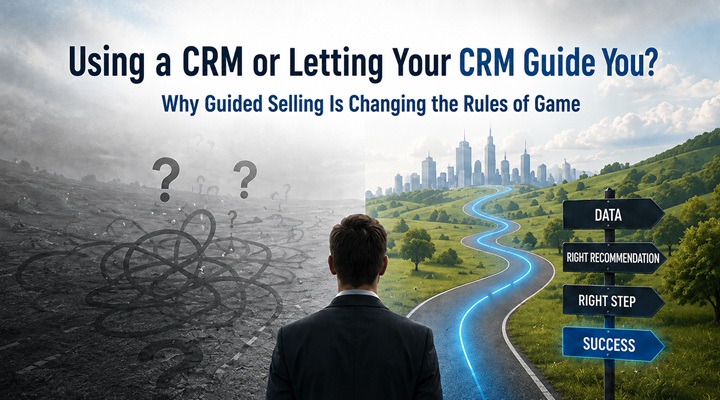
Using a CRM or Letting Your CRM Guide You?
Why Guided Selling Is Changing the Rules of Game
Most sales teams face the same challenge.
A new lead comes in. The first meeting takes place. Requirements are gathered. Proposals are prepared, follow-up activities are planned, and the opportunity starts moving through the pipeline.
At least in theory.
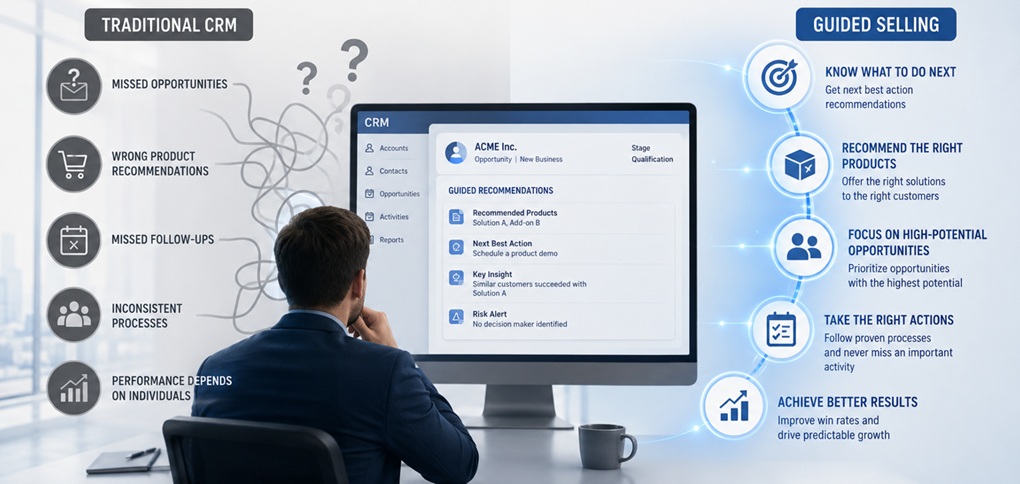
In reality, some opportunities are forgotten, some customers receive the wrong product recommendations, important follow-ups are missed, and sales processes vary from one salesperson to another.
This raises an important question:
Are you using your CRM, or is your CRM guiding you toward the right actions?
The Hidden Limitation of Traditional CRM Systems
When companies invest in a CRM platform, they expect all customer information to be centralized and accessible.
And for the most part, that expectation is met.
However, another reality soon emerges.
Traditional CRM systems record customers, opportunities, and activities, but they rarely answer a critical question:
“What should I do next?”
As a result, experienced salespeople often succeed through their own knowledge and habits, while new team members struggle to achieve the same results.
Sales performance becomes dependent on individuals rather than a repeatable company-wide process.
What Sales Teams Really Need
Successful sales teams do not simply want access to data.
They also want to know:
- What the next best action is
- Which product should be recommended
- Which customer has the highest potential
- Which activity is most likely to move the deal forward
This is exactly where Guided Selling comes into play.
What Is Guided Selling?
The simplest way to describe Guided Selling is as a digital sales coach embedded within the CRM.
The system combines customer information, purchase history, industry knowledge, business rules, and organizational experience to provide intelligent recommendations.
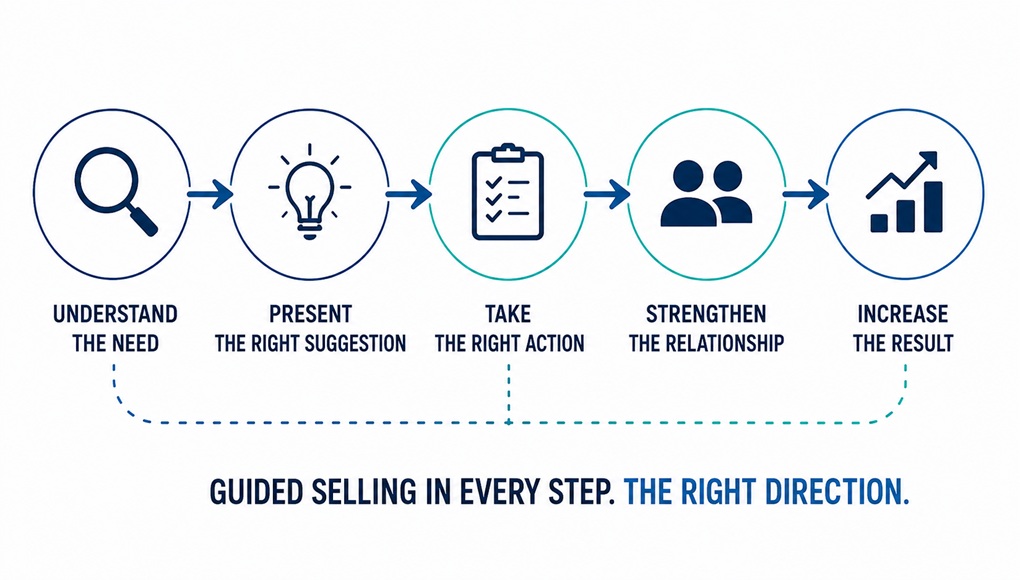
Instead of making every decision from scratch, sales representatives receive guidance throughout the sales journey.
For example:
The system can recommend complementary products.
It can suggest sales approaches that have worked for similar customers.
It can alert users about missing activities or incomplete information.
In some cases, it can even recommend the next best action automatically.
Why Does It Matter?
Because modern sales environments are becoming increasingly complex.
Product portfolios continue to grow.
Customer expectations are rising.
Buying processes involve more stakeholders and longer decision cycles.
Expecting salespeople to remember and process all this information on their own is no longer realistic.
Guided Selling enables organizations to transform years of sales experience into repeatable digital processes.
As a result, the expertise of top-performing sales professionals can be scaled across the entire organization.
The AI-Powered Evolution of Guided Selling
With the rise of artificial intelligence, Guided Selling has entered a new era.
Modern CRM platforms no longer rely solely on predefined rules.
They can analyze customer behavior, learn from historical sales data, and predict which opportunities are most likely to close successfully.
This allows sales teams to make faster, smarter, and more consistent decisions.
As s conclusion, for many years, CRM systems were viewed primarily as repositories of customer data.
Today, expectations have changed.
Organizations want platforms that do more than store information. They want systems that guide sales teams, recommend actions, and support better decision-making.
Because in today’s competitive marketplace, success is not just about having information. It is about turning information into action at the right moment.
Perhaps the real question is:
Does your CRM simply store customer data, or does it work like the most successful member of your sales team?
If you would like to get more information about SAP Sales Cloud V2 Guided Selling, you can contact our expert team.